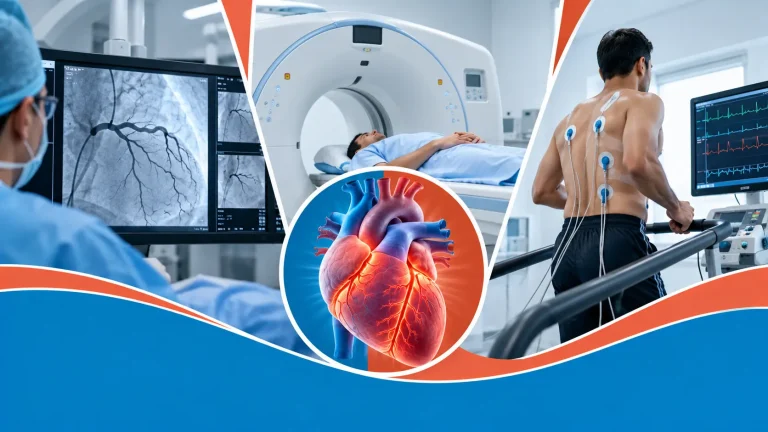
Chest discomfort can leave you with one big question: Is it acidity, tiredness, stress, or something heart-related?
Sometimes chest discomfort is mild and subsides with rest. Other times, you may experience chest pressure, shortness of breath, or pain during activity, which could lead you to consider an angiography, stress test, CT Scan, or MRI.
The good news is that many individuals do not require invasive testing. The physician selects the appropriate cardiac test based on your symptoms, medical background, risk factors, and what they need to find out.
A stress test will show you how the heart responds when it works hard. Conversely, CT angiography provides high-quality images of the coronary arteries.
So, which test among the two is right for your needs? This guide explains and helps you understand all aspects of these tests.
Why Do Doctors Recommend Cardiac Tests?
The primary reason for experiencing chest pain is typically cardiac-related. However, it could be secondary to gastrointestinal issues, muscle strain, anxiety, or an assortment of other health-related concerns.
Chest discomfort in the shoulder area, arms, neck, back, jaw, or upper abdomen can result from decreased blood circulation to the heart. Some people with heart problems may experience shortness of breath or excessive fatigue.
This is why it is important not to decide on your own that a particular test is necessary. Instead, have your doctor evaluate your symptoms, take your blood pressure, review your past medical history, family history, and possible risk factors (diabetes, hypertension, hypercholesterolemia, smoking, and prior heart disease).
Depending on your risk level, you may need no immediate cardiac imaging, a non-invasive test such as a stress test, or an invasive angiography test.
What Is Angiography?
Angiography is the process of using X-rays to see into the veins that transport blood throughout your body. Using this method to assess the condition of your coronary arteries is called coronary angiography (or a coronary angiogram).
Conventional treatment uses a very thin tube (catheter) to guide itself into one of your arteries, commonly from either the wrist or the groin area. Once inside the arteries, a dye with contrasting properties is injected, and multiple X-ray pictures are then taken to provide clear pictures of whether or not you have narrowed or blocked coronary arteries.
Unlike an assessment that only indicates whether blood flow to the heart may be decreased, coronary angiography gives your doctor a clear visual of the coronary arteries. Angiography can help in situations where it is suspected that a patient has severe coronary artery disease, or if test results indicate that further testing is necessary.
When Might You Need Angiography?
Your cardiologist may want to perform an angiography test when:
- You are experiencing symptoms that indicate that you likely have coronary artery disease.
- Previous tests on your heart reveal some type of abnormality indicating that there could be a serious problem with your coronary arteries.
- You know you have coronary artery disease, and now your symptoms have changed in such a way as to require further testing.
- Your doctors believe that there is evidence that there is significantly less blood flowing through your heart than it should.
- Your doctor needs a clearer picture of what’s going on so they can make informed decisions about how best to improve your circulation.
Angiography has one big advantage: it can also be part of your therapeutic pathway. In many cases, if blockages could significantly impact your heart function, your cardiologist will determine the best treatment option for you from among medications, angioplasty, stent placement, or other options.
Angiography is an invasive procedure and therefore carries some risk. Most patients feel that this is an extremely low-risk procedure. The major risks include bleeding or bruising around the area of the body in which the catheters are placed (the insertion sites), allergic reaction during the procedure, and other serious complications.
What Is CT Angiography?
CT coronary angiography (CCTA) is a non-invasive method of obtaining diagnostic images using computed tomography (CT) scans. It also uses a contrast dye for better visualization of the coronary arteries.
This angiogram type uses a venous route and captures images of the heart and surrounding blood vessels. It allows physicians to determine whether there are narrowed areas or plaques within the coronary arteries.
This makes CT angiography a useful option for selected patients, particularly when the doctor wants anatomical information about the coronary arteries without immediately proceeding to an invasive catheter-based procedure.
When Might CT Angiography Be Recommended?
Your physician will consider whether or not you should undergo a CT angiography if:
- You are experiencing chest pain or other related chest problems that would suggest you may have coronary artery disease (CAD).
- Your initial evaluation has not clearly determined the cause of your symptoms.
- Anatomically assessing the heart’s blood vessels (non-invasively) using an imaging modality is appropriate.
- Your physician believes there is either a need to determine the presence of plaque buildup (atherosclerosis) or to confirm stenosis within the coronary arteries.
- Prior studies have produced results that warrant additional testing.
The 2021 AHA/ACC chest pain guideline notes that CCTA can be useful for selected patients with chest pain who are at intermediate risk after an initial evaluation.
What Is a Stress Test?
A stress test examines how your heart will perform under increased workload.
During a typical exercise stress test, you’ll either be walking on a treadmill (or exercising on a stationary bike) as they monitor all of the important functions of your heart, including
- Heart rate.
- Blood pressure.
- Heart rhythm.
- ECG signals.
- Monitor your symptoms to determine how well you can handle the physical exertion.
Unlike an anatomical scan, a stress test doesn’t create images of your coronary arteries. It helps doctors see whether you have symptoms or changes in your heart during exercise that could indicate poor circulation (reduced blood flow) to your heart.
Depending on your situation, your doctor may recommend an exercise ECG or a stress test combined with imaging.
When Might a Stress Test Be Useful?
Stress testing may be indicated in the following circumstances:
- When you have chest discomfort primarily related to exertion.
- If you develop symptoms such as dizziness or shortness of breath while you are active.
- To monitor how well your heart responds to exercise.
- To evaluate possible coronary artery disease.
- To determine if the current therapy is effective, or establish an appropriate safe level of physical activity.
The American Heart Association notes that exercise stress testing can help evaluate possible heart-related causes of chest pain, shortness of breath, and lightheadedness.
Angiography vs CT Angiography vs Stress Test
Understanding the basic difference can make these terms much less confusing.
| Comparison Point | Angiography | CT Angiography | Stress Test |
| Main purpose | Detects narrowing or blockages in the coronary arteries. | Provides detailed images of the coronary arteries. | Evaluates how the heart responds to physical stress. |
| Method | A catheter and X-ray imaging are used with contrast dye. | A CT scan is performed after contrast dye is injected into a vein. | The patient exercises on a treadmill or bike while the heart is monitored. |
| Invasive or non-invasive | Invasive. | Non-invasive. | Usually non-invasive. |
| What it can identify | Coronary artery narrowing or blockages. | Plaque, narrowing, and coronary artery anatomy. | Changes that may suggest reduced blood flow during exertion. |
| When it may be used | When significant coronary artery disease is suspected, or treatment planning is needed. | When a non-invasive anatomical assessment of the coronary arteries is appropriate. | When symptoms occur with exertion or doctors need to assess the heart’s response to exercise. |
The right angiography test will always be based on your symptoms, heart health, risk factors, and diagnosis.
How Do Doctors Decide Which Test You Need?
Doctors often base testing decisions on an individual’s overall risk rather than a single symptom.
Your physician will look at:
Symptoms
Tell your doctor exactly what you feel. Is it a sharp pain, heaviness, burning, etc? Does this happen during rest or when you are exercising? Does it go down your arm, shoulder, jaw, or back?
Risk Factors
Risk factors for coronary artery disease are high blood pressure (hypertension) , high cholesterol levels (hyperlipidemia), type two diabetes, smoking, weight gain issues, older age, and family history.
Previous Test Results
A doctor will also consider results from an ECG, blood tests, echocardiogram, or early stress test when determining whether to have you undergo a CT angiography, a stress test, or angiography.
Your Overall Health
Kidney function, allergies to contrast material, ability to exercise, and other medical conditions can influence which test is suitable.
Whether Treatment May Be Needed
If it’s not just about identifying a condition, or if there is an opportunity for intervention, traditional coronary angiography could be used to obtain information that non-invasive tests can’t.
Most doctors will focus on analyzing the risks. They will never force you for diagnostic testing unless it is needed for high-risk categories.
One thing is for sure that no one will ask you to go for diagnostic testing for chest pain immediately.
What About Coronary Angiography Across India?
You must always choose a hospital with appropriate cardiac and interventional facilities for angiography.
That allows you access to experienced cardiology professionals, diagnostic facilities, and the ability to manage further treatment.
For instance, people searching for cardiologists in Rajkot should discuss the procedure, preparation, possible risks, and expected recovery with their cardiologist before scheduling the test.
The key consideration in choosing an appropriate cardiac evaluation test is to use the best tool to help determine what may be causing your symptoms and assess your overall cardiovascular disease risk.
The Bottom Line
Which type of cardiac testing you will undergo depends on what symptoms you are experiencing, your medical history, and your physician’s assessment.
To determine whether you require an angiography, CT angiography, or another angiography test, the goal is to diagnose the underlying cause of your symptoms so that you may receive proper therapy.
For example, if you are interested in coronary angiography in Rajkot, it would be best to consult a board-certified cardiologist to determine which testing modality is most suitable for you. A timely, accurate diagnosis can help you take better care of your cardiovascular health.
Frequently Asked Questions
1. Can I have heart blockage with a normal stress test?
Yes, you may still have a heart blockage or a plaque buildup even after having a normal stress test. That’s because they can’t detect serious blockages.
2. CT angiogram or nuclear stress test, which is more accurate?
In most cases, doctors consider a CT angiogram to be more accurate than a nuclear stress test. It can detect or rule out coronary artery plaque and blockages.
2. Which is the best test for heart blockage?
An invasive coronary angiogram or cardiac catheterization is generally the best test for heart blockage. Its results are quite accurate and are achieved by inserting a catheter into your wrist or groin.
3. Is CT angio better than angiography?
You cannot call a CT angio or angiography better universally. CT angiography is an excellent option for fast, non-invasive initial screening. However, traditional angiography can be better if the doctor wants to treat blockage during the same procedure.
4. Who should not do CT angiography?
CT angiography is not a good option for individuals with severe kidney kidney diseases or those with allergic reactions to iodine contrast dye. Pregnant women should also remain away from the test, unless suggested otherwise.
5. Is there any life risk in angiography?
Yes, an angiography carries a very low risk to life. There is a very less chance of major, life-threatening complications or death occurring in patients who undergo the test.
6. How many times can CT angiography be done?
There is no strict fixed maximum number of times a CT angiography can be done. However, it is limited by cumulative radiation exposure and kidney function risks from the contrast dye.