
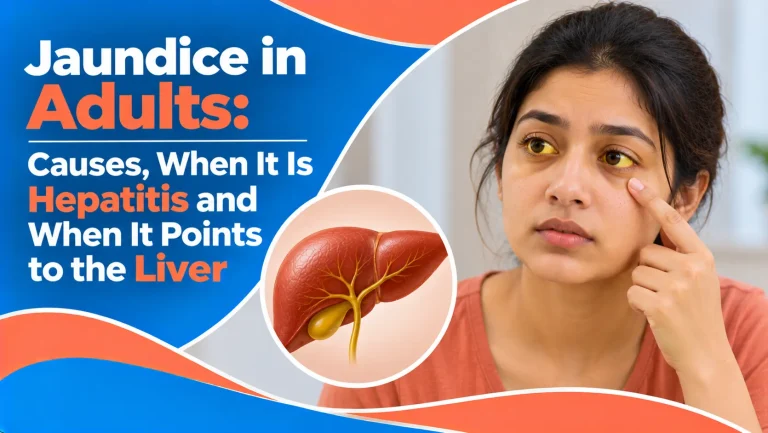
It happens so quietly. You’re looking in the mirror one morning, not because you feel terrible, not because of a fever or that crushing exhaustion that comes with a reason. Just a regular glance at yourself.
Then you see it. Your eyes look pale and yellow. You brush it off, maybe you’ve been up too late, staring at screens too long. These things happen, right? It’s nothing when you don’t actually feel sick.
Dark urine. Tired all day. Not hungry. Then someone at home looks at your eyes and says, “Get yourself checked, you look yellow.”
How Common Is Jaundice in Adults?
Common enough that most families know someone who’s had it. The usual cause here is viral hepatitis, often from water or food that wasn’t clean. It spreads easily in a household, so if one person has it, others should be careful too.
- Consider the reality in India, which accounts for nearly 10% to 15% of the global burden of hepatitis. Right now, around 40 million individuals are chronically infected with hepatitis B, alongside 6 to 12 million managing hepatitis C daily, as per WHO data.
- It can be deadly, too, especially hepatitis B.
- Men face a higher overall risk than women.
- It’s not mostly older people. Half of all chronic cases are adults aged 30 to 54, and alcohol plays a big part.
What Are The Causes of Jaundice in Adults?
Where does the trouble begin? A liver specialist in Mumbai splits it into three categories: before it affects the liver, inside it, and after.
Before the liver: More bilirubin is produced.
- Hemolytic anemia: Fast breakdown of red blood cells
- A large bruise or internal bleed, slowly reabsorbed
Inside the liver: something’s wrong with the liver itself.
- A hepatitis infection (A, B, C, or E)
- Years of heavy drinking
- Fat building up in the liver, which can happen with or without alcohol (MASLD)
- The immune system attacking liver cells
- Some medicines. Taking too much paracetamol (acetaminophen) is a common one. Anabolic steroids and a few antibiotics can do it too.
After the liver: bile flow runs into a blockage.
- Gallstones lodged in the bile duct
- Gallbladder inflammation
- A pancreatic or bile duct tumor pressing on the duct
Category matters here. Treating a blocked duct and treating viral hepatitis are two entirely different playbooks. Mix them up, and the treatment misses.
What Are the Early Symptoms of Jaundice?
- The yellowing of the eyes (jaundice eye), often prior to any skin discoloration
- The yellow discoloration of the skin, more obvious during daylight hours
- Tea-colored urine and clay-colored stools
- Tiredness that doesn’t improve even with rest
- An absence of hunger and some nausea
- Itching of the skin, especially at night
- Feeling a little feverish, experiencing chills, and upper right abdominal discomfort
Not all jaundice symptoms occur at the same time. Some people might only experience changes in their eye color for one or two days. This alone should prompt a bilirubin blood test.
When Is It Hepatitis, and When Does It Point to the Liver Overall?
| Hepatitis | Broader Liver or Bile Duct Disease | |
| What is it | Liver inflammation, in most cases viral | Structural liver damage or a physical blockage |
| Common triggers | Hepatitis A, B, C, or E virus | Use of alcohol, fatty liver, gallstones, tumors |
| Onset | All of a sudden, along with fever and nausea | Mostly slow, developing over years or months |
| Recovery | Hepatitis A and E usually clear on their own | Chronic hepatitis B and C, cirrhosis, and blockages require consistent or procedural treatment |
| Jaundice pattern | Accompanies acute illness, slowly fades away | In some cases, it’s continuous; sometimes it recurs mainly when there is an underlying cause. |
What Does High Bilirubin Actually Mean?
Doctors typically start with one number: bilirubin.
| Type of Bilirubin | Normal Range |
| Total bilirubin | 0.1 to 1.2 mg/dL |
| Direct (conjugated) bilirubin | 0.0 to 0.3 mg/dL |
| Indirect (unconjugated) bilirubin | 0.2 to 0.8 mg/dL |
What the numbers tend to suggest: Here’s the short version.
- Normal (up to 1.2 mg/dL): You’re fine.
- Mildly raised: Your liver specialist in Mumbai will ask a few questions. Have you been drinking? Taking new medicines? Any stomach pain or fever? The answers, along with a couple of extra tests, usually point to the cause, whether that’s the liver, the gallbladder, or the blood.
- Above 3.0 mg/dL: Expect yellow eyes, possibly dark urine too. This is when a doctor’s visit becomes urgent rather than routine.
Which type of bilirubin is elevated matters too. A direct bilirubin spike usually points to a blockage, with gallstones as the most common culprit.
Mostly, indirect bilirubin usually points to one thing. This usually means red blood cells are breaking down too quickly. Your liver can’t clear the bilirubin at the same speed.
How Can Doctors Detect the Underlying Causes of Jaundice?
Spotting jaundice symptoms takes seconds. Working out what’s behind them can take a couple of tests.
- A bilirubin test can help identify which type of bilirubin is causing the disorder.
- The liver function test includes enzyme testing such as ALT and AST.
- A test that will help to diagnose hepatitis A, B, C, and E is known as a hepatitis panel.
- The physician will use ultrasonography of the gallbladder to check whether any blockage exists or not. It will also help to diagnose an enlarged liver and gallstones.
- Finally, liver biopsy may help to find out unknown cases and the seriousness of chronic disease.
How Jaundice is Treated in Adults?
Jaundice symptoms can’t be treated on their own with pills. All treatments try to find out the reason behind increased levels of bilirubin.
- Treatment of hepatitis A/E involves rest and hydration for a number of weeks.
- For hepatitis B/C, the treatment includes antiviral drugs.
- If there is liver damage caused by too much alcohol intake, the patient should stop drinking alcohol.
- Obstruction of bile ducts or gallstones may be treated with either an ERCP procedure or surgery.
- Autoimmune liver disease is rather rare, so you may need medicines like steroids to suppress the body’s defense reaction against your liver.
- In addition, you will most probably be asked to undergo further bilirubin tests, hydrate yourself, and get enough rest.
What Should You Eat and Avoid During Jaundice?
Food plays a big role here. Mild food allows the liver to do less work.
Best to Avoid:
- Alcohol, in any amount at all
- Fried or heavily oily dishes
- Red meat and other proteins that take longer to digest
- Packaged snacks loaded with salt and preservatives
- Sugary drinks and excess sugar generally
Better Choices:
- Fresh fruit, papaya, and citrus work particularly well
- Mild portions of vegetables cooked softly and whole grain foods
- Drinking much water and coconut water
- Moderate amount of protein food, such as lentils, eggs or fish
What Red Flags of Jaundice Should Prompt an Urgent Visit to the Doctor?
- Eyes or skin turning yellow suddenly or worsening fast
- High fever with chills alongside the yellow tinge
- Sharp pain under the ribs on the right side
- Vomiting blood, or blood showing up in stool
- Confusion, extreme drowsiness, trouble staying alert
- Jaundice that’s stuck around for more than two weeks
- Weight loss with no clear explanation, alongside the yellowing
When Should You Visit A Doctor?
Yellowing of your eyes indicates that your body is sending you a message. Most likely, it is related to your liver but may also be associated with your bile ducts or blood vessels. It should definitely be investigated and not ignored.
Most causes of jaundice are curable. At Wockhardt Hospitals, our liver specialist in Mumbai will help you through the process.
Frequently Asked Questions
1. What do dark urine and pale stool mean?
Dark urine is a common sign of high bilirubin. Pale, greyish stool is different. It can point to a blockage in the bile ducts. Either way, your doctor will want to know.
2. At what bilirubin level should I worry?
Normal is usually up to 1.2 mg/dL. Once it reaches 2.5 to 3 mg/dL, the yellow color often starts to show. Don’t wait it out. Get checked.
3. Can tablets cause jaundice?
Some can. We see it with paracetamol overuse, TB medicines, certain antibiotics, and quite often with herbal powders bought online.
4. Is jaundice something you can pass on?
Not by itself. What matters is the cause. Hepatitis A and E can spread through dirty water or unsafe street food. Hepatitis B and C pass through blood. However, if alcohol or gallstones are responsible, it cannot be transmitted to others.
5. Does smoking slow down recovery?
It can. Smoking adds more strain to an already struggling liver and may also raise the risk of liver disease getting worse over time. This is a good time to cut down or quit.
6. What should I stop eating?
Alcohol is the first thing to go, in any amount. Fried food, red meat, and processed food should be avoided too. Your liver is already under strain, and these only make it worse.
7. Is there a quick fix?
No, really. Jaundice treatment in adults is not a one tablet thing. It’s about addressing the real problem and allowing your liver to recover.


