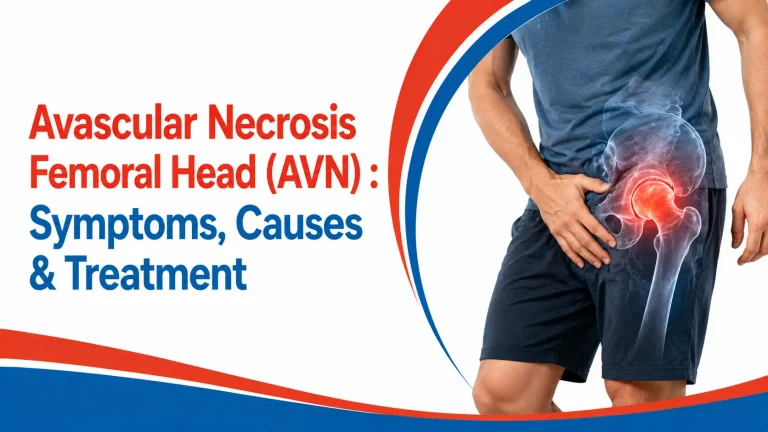
It’s easy to shrug off a dull, deep ache in your groin as just a pulled muscle, especially if you only notice it while climbing stairs. But for many, that quiet discomfort is actually the first warning sign of a serious bone issue that only gets tougher to handle the longer you wait.
Avascular necrosis of the femoral head, also called “osteonecrosis”, happens when the top of the thigh bone loses its blood supply and slowly begins to die. It continuously strikes the hip joint. If it is caught early, the damage can be slowed down, but if it is ignored, the bone can dig in and wear out the whole joint.
This blog explains the warning signs of AVN, what sets the condition off, how doctors find it, and the treatment choices available.
What Is Avascular Necrosis of the Femoral Head?
Bone is a living tissue, and it needs a steady flow of blood to stay healthy. Avascular necrosis (AVN) is what happens when that flow is cut off, and part of the bone starts to die. The name is easier than it looks. The “A” stands for without, while “vascular” means blood vessels, and “necrosis” means the death of the tissue. Doctors also use the word osteonecrosis, which just means bone death.
Without the supply of fresh blood, tiny cracks can start to form inside the bones. Over months, the weakened area can begin to collapse.
Most cases appear between 30 and 50 years old people. In India alone, doctors diagnose an estimated 80,000 to 90,000 new cases every year. Anyone can get affected by it, which is why the early signs are worth knowing.
Symptoms of Avascular Necrosis of the Femoral Head
Early avascular necrosis symptoms can be silent. Plenty of people feel nothing while the damage is small. As the bone weakens over time, many people start feeling the pain. At first it can show up when the joint carries weight, and later it can start nagging even during rest.
Pain from a bad hip is often first felt in the groin area. Some people notice it in the thigh or the buttock instead. The most common signs are:
- Mild, nagging pain that can get worse with time.
- Joint getting stiff, making it harder to move around like you usually do.
- Pain that spreads from one spot to other areas.
- Struggle standing up or walking for long.
- Muscles around the joint that grow weak and shrink from being used less.
- In severe cases, the bone can collapse and bring sharp pain.
Pain that lingers for more than a few weeks, or that wakes a person at night, is a solid reason to have the hip checked.
Causes of Avascular Necrosis of the Femoral Head
Blood reaches the femoral head through a small set of vessels. If there is anything that blocks or damages these vessels, it can starve the bone. Several injuries and health problems can cause avascular necrosis of the femoral head. This can include:
- Injury or Trauma: A hip dislocation or a broken bone can tear the vessels that supply blood to the femoral head.
- Steroid Medicine: Long-term or high-dose steroids, often given for asthma, arthritis, or immune conditions, can raise the risk by changing how blood vessels work.
- Heavy Alcohol Use: Drinking a lot over many years can clog vessels with fat and weaken bone, especially around the hip.
- Certain Medical Treatments: Radiations given for cancer can also harm bones. Many organ transplants, like a kidney transplant, are linked to causing AVN.
- Bisphosphonates: This is a bone-strengthening drug, and in rare cases can cause bone death in the jaw. The risk is higher in people treated for multiple myeloma or breast cancer.
AVN that is not caused by an injury is tied to several other conditions. Among them are:
- Diabetes
- HIV
- Sickle cell disease
- Pancreatitis (swelling of the pancreas)
- Gaucher disease (a build-up of fat inside the organs)
- Decompression sickness (gas bubbles in the blood from fast pressure changes)
In more than half of people, both hips are affected, so a problem on one side is a signal to keep an eye on the other.
How Is Avascular Necrosis of the Femoral Head Diagnosed?
Getting AVN diagnosed early can give a real chance to save the joint. A doctor usually starts with questions and a hands-on check, then confirms the diagnosis with imaging.
Medical history and physical exams usually come first. Your doctor will then ask about the pain, any past injuries you had, or medications you have been taking.
To see how much damage there is, doctors rely on imaging tests:
- An X-ray is often the first step, as it can clearly show if the bone’s shape has changed or if the joint is starting to collapse.
- Magnetic resonance imaging (MRI) can give detailed pictures and can catch AVN in its very first stage.
- A computed tomography (CT) scan can offer cross-section views which can help map out the exact bone damage done.
- Bone scans act as a small, safe tracer that highlights areas where blood flow might be restricted.
- Biopsy is usually the last option, where a small piece of bone is checked under a microscope.
Understanding the Stages of AVN of the Femoral Head
AVN gets worse in stages. Spotting it in an early stage can make the treatment far more successful.
- Early Stage: At this stage, the blood flow to the femoral head drops and bone cells begin to suffer. The bone can still hold its shape, and there may be no pain yet. An MRI can pick up these changes easily.
- Bone Death Stage: This is the second stage, where the blood flow is still cut off, and now the bone tissue starts dying. Pain often starts at this stage, mostly when the weight falls on that weakened hip. Here, rest and medicine are advised by doctors.
- Crescent Stage: In this stage, dead bone weakens, and a small crescent-shaped crack starts to form under the surface. The pain and stiffness can grow here, so a joint-saving operation such as core decompression can be considered.
- Flattening Stage: Here, the round femoral head starts losing its shape. The movement drops, and the pain can increase. At this stage, it is recommended to get hip replacement surgery.
- Advanced Stage: This is the final stage. The joint damage over here is very severe and can affect mobility a lot. At this point, a total hip replacement is usually the best way to get you moving comfortably again.
More than half of the people with AVN need surgery within three years of diagnosis.
Treatment of Avascular Necrosis of the Femoral Head
The care and treatment used depend on how much bone is damaged and how far the condition has progressed. The end goal is to reduce the pain, protect the joint, and stop bone loss.
A guided physiotherapy plan can keep the joint moving, build the muscles around it, and take the pressure off of the damaged bone. Engaging in simple exercises under the therapist’s watch can also help keep the body moving.
When the condition is more advanced, surgery is often needed. Some common procedures include:
- Core Decompression: In this, the surgeon drills one or more small channels into the femoral head to lower pressure and allow new blood vessels to grow in there. Sometimes bone grafts or injections may also be added. It is usually done before the bone collapses, and can significantly slow down or even reverse early AVN.
- Bone Grafting: In it, the surgeon takes a piece of healthy bone and replaces it with the damaged bone.
- Joint Replacement: When the bone , the best fix, is too damaged, it is replaced with an artificial one.
Getting Timely Care
Hip pain that continues to bother you even after medications and heat pads should be taken seriously. Early diagnosis lets a doctor pin down the exact stage of your AVN and match you with the right care available.
The orthopedic treatment chosen at an early stage is usually gentler and more likely to protect the natural joint.
FAQs on Avascular Necrosis of Femoral Head
1. Can avascular necrosis of the femoral head heal without surgery?
In its early stages, avascular necrosis of the femoral head can sometimes improve without surgery through proper medicine, physical therapy, and some lifestyle changes. For more advanced cases, they usually need proper surgery to stop further damage and restore the joint.
2. Can avascular necrosis patients walk?
If avascular necrosis affects parts of the body that bear our weight, like the hip or knee, walking can feel harder.
3. How to naturally treat avascular necrosis?
There is no natural way to treat avascular necrosis. However, some habits like consuming a proper diet rich in calcium and vitamin D, exercising, and reducing smoking and drinking can help a lot.
4. Is avascular necrosis serious?
Yes, it’s serious, as it can happen when the blood supply to the bone is blocked.
5. Can avascular necrosis affect both hips?
Yes, more than half of people with AVN of the hip joint have it in both hips. If you feel pain in one hip, it’s a good reason to have the other one checked as well.