
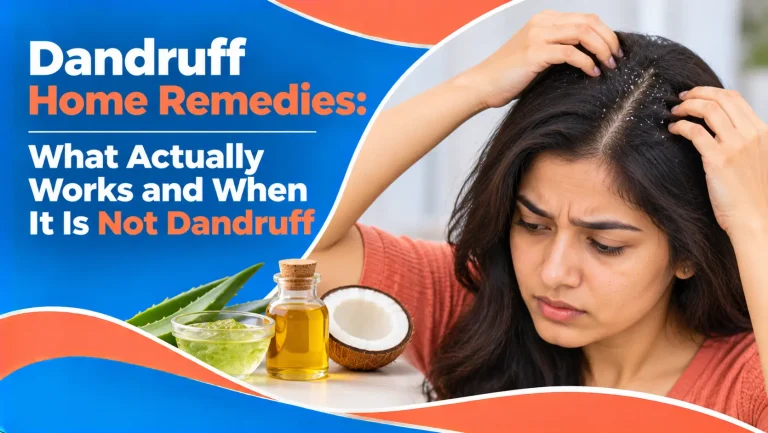
You wear a black kurta to a wedding, and by the second hour, white flakes appear on both shoulders. Sometimes, dandruff is hard to ignore. A few flakes on your shoulders, an itchy scalp, and before you know it, you are reaching for your hair again.
It is common too, affecting around half of the population at some point. But overcoming the problem can be confusing. Most of us handle it with what a friend assures us works: lemons, curds, and a tablespoon of baking soda. A few of those help. Others leave the scalp raw. This guide covers:
- Which dandruff home remedies have real evidence
- How to run dandruff treatment at home
- How to tell when flakes point to something else
How Do You Get Dandruff and an Itchy Scalp?
Dandruff is not dangerous. It looks like:
- White skin flakes on the scalp and hair. In some cases, there is dryness and itching.
- Is it contagious? No
- Is it a sign of dirty hair? No
- Malassezia is part of the picture. This yeast normally lives on the scalp and uses skin oils as a food source. The issue arises when the scalp reacts more strongly, which may cause irritation and faster shedding of skin cells.
Other itchy scalp causes have a similar appearance:
- Contact dermatitis – a reaction to a newly used shampoo, hair dye, or styling gel
- Eczema – dry, flaky patches that get irritated easily
- Psoriasis – flaky, scaly patches that grow out of the hairline
- Ringworm – a type of fungus causing round scaly patches
Cold climate and low humidity are also common triggers. This is the reason why flakes worsen during the winter months.
Which Dandruff Home Remedies Actually Work?
Few kitchen remedies have been tested in trials. Here’s where each one stands:
| Remedy | What the Evidence Says |
|---|---|
| 5% tea tree oil shampoo | In a 4-week trial of 126 people, itching improved by 23% with tea tree oil and 12% with a dummy shampoo. Only 1 person in each group cleared completely. |
| Aloe vera, neem, fenugreek, curd | It gives a soothing effect to many people. However, evidence for treatment is limited. |
| Coconut or olive oil | No trial backs either one as a treatment. The yeast lives on scalp oils, so leaving oil on your head for hours may not help. |
| Lemon juice, baking soda | No evidence. Both can sting and dry out a flaky scalp. |
But How Do You Safely Try Any Dandruff Home Treatment?
Even natural treatments can irritate you. Your flaky skin is quite reactive, so here is what to do first:
- Apply some to the inside of your forearm. Wait for 24 hours.
- Introduce only one remedy at a time so that you know where the problem lies.
- Don’t apply full-strength essential oils to your scalp.
How to Treat Dandruff at Home?
Combining different treatments won’t work. But if you stick to a single routine, it will give results.
Step 1. Purchase your shampoo with a proven active ingredient listed below.
Step 2. Rub it into your scalp, not only your hair. Allow it to sit according to the directions in the package.
Step 3. Give it up to 4 weeks. Doctors say it may take trying several different products before you find one that works.
Step 4. Switch only if a full month brings no change.
Step 5. In case you doubt the technique, consult with a pharmacist.
There are two practices to be followed while using the shampoo:
- Wash the combs, brushes, caps, and scarves that touch the scalp.
- Use one recommended shampoo only. Compared to the trial-and-error approach in the treatment with various anti-dandruff solutions, the correct use of the proper solution is more effective.
What Are the Best Anti Dandruff Remedies to Buy?
Anti dandruff formulations are customized specifically to target yeast overgrowth and include options such as:
- Ketoconazole (2%) is used as a first-line treatment for dandruff
- There is more than one way to manage dandruff. Zinc pyrithione (1%) and selenium sulfide (0.5%–1%) are also treatment options.
- Salicylic acid works differently by helping loosen the scales from the scalp.
Which Home Remedies Should You Skip?
A few popular fixes do more harm than good on a scalp that’s already irritated:
- Lemon juice: It’s acidic and has a burning effect on your scalp.
- Baking soda: It is one of the exfoliating agents that shreds natural oil from your scalp.
- Overnight oil masks: If yeast drives your flakes, extra oil may make no difference
How are Dandruff and Seborrheic Dermatitis Different?
They are closely associated. Some research suggests dandruff is the non-inflammatory form of seborrheic dermatitis. In short:
- Dandruff: Flaking without much redness. It affects about half the population.
- Seborrheic dermatitis: It causes flakes along with inflamed, red skin. It affects about 5% of the population worldwide.
The same shampoos treat both. But the inflamed form is more likely to need a doctor.
What Other Conditions Look Like Dandruff?
People often blame dandruff for everything, but some other conditions look the same. They need different treatment.
| Signs | Possible Cause |
|---|---|
| Red, swollen, greasy scalp with yellow scale | Seborrheic dermatitis |
| Thick, raised, silvery patches | Psoriasis |
| Round, scaly patches with hair loss | Ringworm |
| Itching that began after a new product | Contact dermatitis |
| Itchy, flaky skin patches on your face or body | Seborrheic dermatitis or eczema |
When the cause is unclear, a doctor can help confirm the diagnosis.
- A stubborn, inflamed scalp needs a doctor’s opinion:
- Seborrheic dermatitis is found in individuals who have poor immunity or suffer from neurologic disorders such as Parkinson’s disease.
- When flaking does not respond to any treatment, it’s time for a professional intervention.
When Should You Visit a Dermatologist?
If you are dealing with the points below, then it’s time to book an appointment with a dermatologist:
- You have used anti-dandruff shampoo for more than 4 weeks, but you still haven’t gotten rid of dandruff.
- You have very bad dandruff or itching
- Your scalp is red or swollen
- You have flaky, itchy patches on your face or elsewhere on your body
Patchy hair loss is one more reason. It points away from plain dandruff.
Why Should You See a Dermatologist in Mira Road at Wockhardt Hospitals?
If a month of the right shampoo hasn’t worked, plain dandruff may not be the problem, or you may need a prescription. A consultation with a dermatologist can clarify the issue in a single visit.
Wockhardt Hospitals has an experienced team for anyone searching for a dermatologist in Mira Road. The team includes:
- Dr. Anjana Gala: Dermatology and trichology (the study of hair and scalp)
- Dr. Ishwari Kulkarni: Dermatology
A dermatology consultation costs ₹1,500 to ₹5,000, depending on the doctor and your condition.
Bring these to your visit:
- When the flakes started
- Which shampoos you’ve used, and for how long
- Any new hair products or medicines
Frequently Asked Questions
1. Will anti-dandruff shampoo dry out my hair?
Some can leave your hair feeling a bit dry, especially the lengths. Using a conditioner on the ends usually sorts that out. Just keep it off your scalp.
2. Does hard water cause dandruff?
Nobody’s shown that it does. Some people notice their hair feels drier or rougher in hard water areas. Fitting a shower filter might help with that. Your dandruff, however, is most likely down to something else.
3. Does tea tree oil help?
Maybe a little. There’s some small-scale research on shampoos containing tea tree oil, and the results looked promising. That’s about as far as the evidence goes. Never put neat tea tree oil on your scalp, though.
4. Could my diet be causing it?
There’s no strong proof that any particular food causes dandruff or cures it. Eating well is good for your skin in general, of course. Just be wary of anyone promising that cutting out one food will fix your scalp.
5. Is it safe to use medicated shampoo every day?
Depends on the product. Some are fine for regular use, while others are meant for a couple of times a week. The label will tell you. If your scalp starts feeling tight, dry, or sore, cut back.
6. Do men get dandruff more than women?
Slightly more, it seems, likely because of differences in oil production. Women get it plenty too, though, and the treatment’s the same.
7. Is it worth alternating two shampoos?
For some people it makes a real difference. Say one has ketoconazole in it and the other has zinc pyrithione. You’d just swap between them through the week. Handy if you feel like your usual one has stopped working as well as it did.
8. Should I try a scalp scrub?
If you want to. Just go easy. Scrubbing lifts flakes off, and yes, it feels satisfying, but too much pressure leaves the skin sore. Stinging afterward means you’ve overdone it. For most people, a medicated shampoo will do more good anyway.


