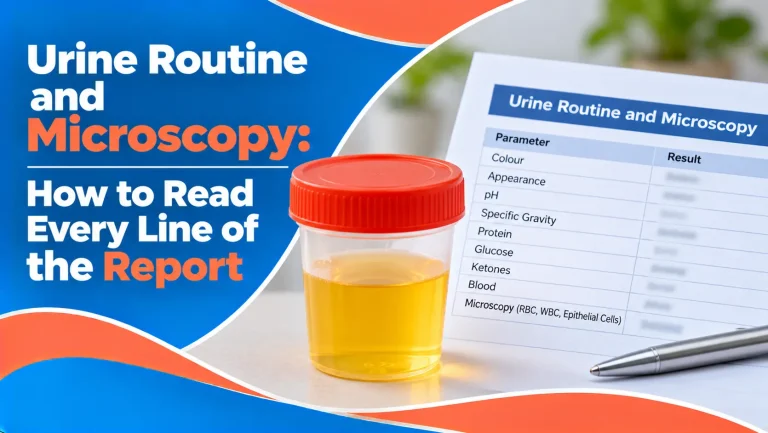
Most routine urine test reports run about 10-12 lines. A couple prints in red, and that’s usually where your eye goes first.
One test, 3 answers. You’ve got your urine test report in hand, and it’s full of terms you’ve probably never heard of. Don’t worry, it’s easier to read than it looks.
Let us explore the topic in this blog so you understand the urine routine test, what to do when results are abnormal, and when to consult a nephrologist.
What Is a Urine Routine and Microscopy Test?
You’ll usually see it written as UR/ME or R/M on your lab slip. It is a three-fold assessment of the sample of your urine:
- Physical examination: Color, appearance, and quantity
- Chemical examination: Strip tests for determination of pH, protein, glucose, and ketone bodies
- Microscopic examination: Cells, casts, crystals, and bacteria are examined under the microscope
Your doctor may ask for it:
- During a yearly checkup or before surgery
- At regular visits during pregnancy
- If peeing hurts, your lower back aches, or you’ve had a fever with no clear cause.
It’s cheap and quick, but don’t let that fool you. This simple urine routine test catches many UTIs and early kidney problems.
What Is the Urine Routine and Microscopy Test Normal Range?
Labs vary slightly on exact cutoffs. The table ahead lists the ranges most commonly followed.
| Parameter | Normal Range |
|---|---|
| Color | Pale yellow to amber |
| Clarity | Clear |
| pH | 4.5 to 8 |
| Specific gravity | 1.005 to 1.025 |
| Protein | Negative or trace |
| Glucose | Negative |
| Ketones | Negative |
| WBC (pus cells) | 0 to 5 per HPF |
| RBC | 0 to 2 per HPF |
| Epithelial cells | 0 to 15-20 per HPF |
| Casts | 0 to 5 hyaline casts per low-power field (LPF) |
| Bacteria | None or occasional |
One value drifting outside these numbers isn’t automatically worrying. A handful of everyday factors can nudge a single reading:
- A heavy meal or certain foods eaten before the test
- Not drinking enough water
- A workout shortly before the sample
- A sample collected too quickly or incorrectly
What Do Pus Cells in Urine Mean?
It’s an unpleasant name for something quite ordinary. These are white blood cells, your body’s defenders, showing up in the urine when something needs fighting off.
- Anywhere from 0 to 5 per HPF is nothing to worry about.
- 6 to 10 points toward mild inflammation, occasionally just from an imperfect sample
- Between 6 and 10 may point to slight inflammation, though an imperfect sample can also cause it.
A high pus cell count isn’t a diagnosis. It tells your doctor to look further, usually with a urine culture, before assuming bacteria are to blame.
What Does the Physical and Chemical Part of the Report Show?
Before the microscope comes in, the lab looks at your sample and runs a few quick chemical checks. These results appear here.
- Dark or cloudy? Such a result could indicate dehydration, an infection, or blood. Bright yellow is a different story. It’s usually harmless and often comes from vitamin B supplements.
- Specific gravity shows how concentrated your urine is. Drinking plenty of water lowers it. Not drinking enough raises it.
- Urine pH value tells you whether your urine leans acidic or alkaline. It changes with what you eat, and a single reading outside the normal range isn’t usually a cause for concern.
- A one-time positive protein result is not alarming. A rechecked positive result requires a medical examination of your kidneys.
- If glucose is detected in your urine, your doctor will screen for diabetes.
- Ketones appear in fasting, on the diet, or in poorly controlled diabetes.
What Else Can Show Up in the Microscopy Section?
- Red blood cells shouldn’t show up in large numbers. A count above 2 to 3 per HPF often means infection or stones somewhere in the urinary tract. Occasionally, the kidneys themselves are involved.
- Seeing some epithelial cells is routine. Seeing a lot usually isn’t a health problem. More often, it means the sample wasn’t collected cleanly and picked up cells from the skin.
- A few hyaline casts? Usually fine. Granular or cellular ones? Those deserve attention, since they can be an early sign that something is affecting the kidneys.
- Crystals show up after certain meals fairly often; the same type appearing again and again can raise kidney stone risk
- Bacteria seen together with high pus cells; this makes a urine culture the obvious next move
When Does the Report Call for a Urine Culture?
Your doctor may recommend a urine culture test when:
- Pus cells run high, and symptoms like burning or urgency are present
- Nitrites or leukocyte esterase come back positive
- Symptoms linger even though the routine report reads borderline
- Two or more UTIs within a six-month span
A urine routine test report can tell you there’s an infection. A culture identifies the bacteria behind the infection and the antibiotic that will treat it. It takes longer, but it helps you avoid medicines that won’t work, which is one common reason infections keep returning.
What Causes Abnormal Urine Routine Results?
- Urinary tract infections are the most common cause. They’re behind most cases of high pus cells and positive nitrites.
- Kidney stones can raise your red blood cell count and cause crystals to appear in the sample.
- Sometimes the cause is simple: you didn’t drink enough. A concentrated sample can push a few results just past normal.
- Sugar in your urine can be one of the first signs of diabetes, sometimes before any symptoms appear.
- Early kidney disease, suggested by persistent protein or abnormal casts
- Poor sample collection, an easy and completely harmless explanation for a single abnormal report
When Should You Consult a Doctor?
- Burning or painful urination lasting more than a day
- Cloudy, foul-smelling, or blood-tinged urine
- Fever with lower back or side pain
- Protein or blood appearing in two separate urine test reports
- More than one UTI in a short stretch, especially if they keep returning
- Unexplained swelling around the eyes or legs when your urine test is also off
If you notice any of these, get them checked without delay. Most of the time, a doctor’s visit and a culture are enough to find the cause and start the right treatment.
Getting a Urine Report Read Right, Not Just Handed Back
A urine routine and microscopy test is a screening tool. It points to possible problems but doesn’t confirm them. A repeated pattern, particularly with protein, RBCs, or microscopic casts, is what actually warrants a conversation with a specialist.
Mira Road residents holding a urine report full of open questions, or facing recurring UTIs, unexplained swelling, or protein in the urine, don’t have to figure it out alone. A nephrologist in Mira Road can help you understand what’s going on.
At Wockhardt Hospitals, Mira Road, kidney specialists like Dr. Puneet Bhuwania and Dr. Nikita Pawar can review your urine report with you. When required, a culture test and kidney function test will be done for you, and an explanation of what happens next will follow.
Frequently Asked Questions
1. What is UR/ME?
It’s short for urine routine and microscopy. It’s a full check of your urine: how it looks, what’s dissolved in it, and what turns up under a microscope.
2. Will this test show if I have kidney disease?
Sometimes it gives the first clue. A UR/ME can pick up early warning signs, such as protein or blood in the urine. Confirming kidney disease takes more, usually a blood test for creatinine and a urine albumin test.
3. My urine looks foamy. Is that a problem?
Occasional foam is usually nothing, especially if you urinate forcefully. Foam that appears every time and doesn’t settle may mean protein in the urine. It’s worth mentioning to your doctor.
4. What are crystals in urine?
Crystals form when certain minerals build up, often because you’re not drinking enough water. A few are common and harmless. Large amounts, or specific types, can be linked to kidney stones.
5. Do pus cells always mean an infection?
Not really. A rushed or poorly collected sample can show a slight elevation, usually cleared up with a proper repeat sample.
6. Can last night’s dinner change my report?
Sometimes, yes. If you ate beetroot, your urine may look reddish. A heavy meat meal can change the pH. And if you didn’t drink much water, the sample may look darker than usual. None of this means something is wrong.
7. Should I come on an empty stomach?
No. You can have your breakfast. Just make sure to collect a clean midstream sample, preferably the first one of the day.