Your periods arrive every 50 days, and last quarter one skipped entirely. A friend says it’s PCOD. Your aunt insists it’s PCOS. An Instagram reel promises to reverse it in 30 days. Which one do you have, and does the name even matter?
It matters less than most articles claim. Your body’s signs count for more than the name on the report. Two numbers show why:
- WHO estimates that 8% to 13% of women worldwide have PCOS.
- Up to 70% of them have no diagnosis.
Understanding what PCOD and PCOS mean is how you start getting answers.
This blog breaks down the PCOD PCOS difference, the symptoms that deserve a doctor’s attention, and whether PCOD can be cured. And we’ll highlight the red flags you should never ignore.
What Is the PCOD Full Form, and What Is PCOS?
The two names, spelled out:
- PCOD: Polycystic ovarian disease
- PCOS: Polycystic ovary syndrome
Many patients and clinics across India treat them as separate illnesses.
The 2023 international guideline on PCOS doesn’t treat these as separate conditions. It sees them as one. In May 2026, an international panel gave that condition a new name: polyendocrine metabolic ovarian syndrome, or PMOS.
The Endocrine Society says the traditional name ignored systemic hormonal and metabolic effects and that the ovaries don’t actually contain extra abnormal cysts.
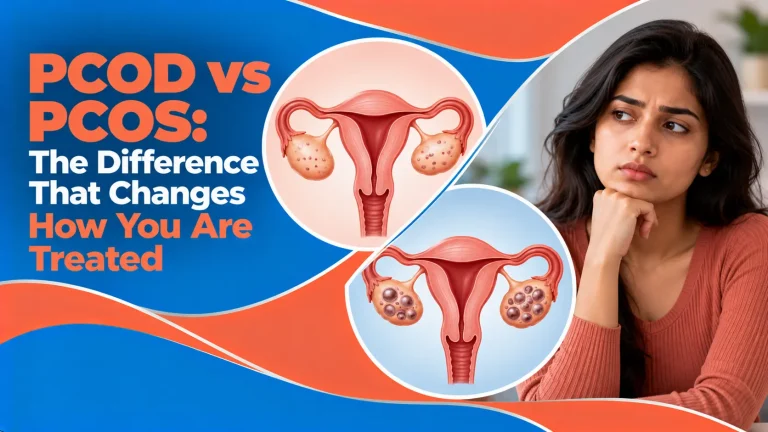
What Is The Real PCOD vs PCOS Difference?
Here is the version most Indian clinics use, and the one UNICEF India describes. PCOD is the milder form, where the ovaries release immature eggs and cycles wobble. PCOS is the more severe hormonal and metabolic disorder, driven by excess androgens, which are male-type hormones.
| PCOD | PCOS | |
| Ovulation | Usually continues, sometimes late | Often stalls |
| Hormones | Mild imbalance | Excess androgens |
| Metabolism | Weight gain is common | Insulin resistance, higher diabetes risk |
| Fertility | Conception is usually easier | Often needs treatment |
| First step | Lifestyle changes | Lifestyle plus medicines |
Therefore, the PCOD/PCOS difference in treatment is not the name. What matters is which findings you exhibit and how high your metabolic risk is. A slender woman who suffers from irregular menstruation but whose sugar levels are normal requires a different approach from a woman who has acne, dark skin coloration around her neck, and progressively increasing fasting sugar levels despite all.
How Common Is It In India?
Numbers shift with the study. Research from southern India and Maharashtra, cited by UNICEF India, found PCOD in 22.5% of menstruating women and PCOS in 9.13%. Research from southern India and Maharashtra, cited by UNICEF India, puts the numbers higher than many expect. PCOD showed up in 22.5% of menstruating women. PCOS, in 9.13%. Methods differ between studies, so read those as rough estimates.
What Are The PCOS Symptoms?
Below mentioned are some common PCOS symptoms:
- Fewer than 8 periods a year, or gaps of many weeks
- Extra hair on the face, chest, or belly, seen in up to 70% of women with PCOS
- Acne on the face, chest, and upper back
- Thinning hair on the scalp
- Weight gain around the belly, or trouble losing weight
- Dark, velvety patches on the neck folds or groin
- Skin tags in the armpits or on the neck
- Difficulty becoming pregnant
- You don’t necessarily require each one. Your PCOD or PCOS symptoms determine the plan.
How Does Your Gynecologist Identify PCOD and PCOS?
There is no one test that could provide confirmation of this disease. Your gynecologist first needs to evaluate your medical history and measure your body mass index and blood pressure.
Confirming PCOS requires meeting at least two of these criteria, with no distinct medical test distinguishing PCOD from PCOS. Because a scan only addresses a single criterion, an ultrasound report noting “cysts” is insufficient on its own to make a diagnosis.
Is PCOD Curable?
No, there is no cure for PCOS; however, it is a manageable chronic condition. Any website promising a cure in three months is selling something.
Losing 5 to 10% of your body weight can help bring your periods back on track. Some women need nothing more than lifestyle changes. Others do better with medicine as well.
Treatment options include:
- A balanced diet and staying active. The WHO puts these at the top of the list.
- Combined oral contraceptive pills to make periods more regular
- Anti-androgen medicines for excess hair and acne
- Metformin, when insulin resistance is present
- Clomiphene, IVF, or ovarian drilling when you are trying to conceive
It’s up to your gynecologist to select what’s needed in your case. The course of treatment will depend on the influence PCOS has on you and whether you plan to get pregnant.
What Happens If You Ignore It?
PCOS left unmanaged can take a toll. By 40, over half of women with the condition have diabetes or prediabetes. WHO also lists these risks:
- High blood pressure
- Heart disease
- Obesity
- Endometrial hyperplasia, which can progress to endometrial cancer
None of this is guaranteed. But treating things early brings the risk down, even if all you’ve noticed is irregular periods.
What Should You Change In Your Daily Life?
Before anything else, the WHO recommends looking at food and movement. Most of the improvement comes from here, largely because PCOS and insulin resistance so often go together.
On your plate:
- Choose whole grains over white bread, biscuits and sugary chai
- Make dal, vegetables, eggs or paneer the heart of your meals
On your feet:
- WHO advises at least 150 minutes of moderate activity a week for adults
- A brisk 30-minute walk on five days gets you there
Can You Get Pregnant With PCOS?
Often, yes. If ovulation has stalled, doctors can help get ovulation going again through:
- Weight loss
- Letrozole
- IVF, when needed
Here’s the thing about PCOS and pregnancy. The risks are real, but you can minimize them. Speak with your doctor prior to conceiving.
When Should You See A Doctor?
Your report may say PCOD or PCOS. Either way, book a visit if any of these PCOS symptoms or signs show up:
- Your periods come only a handful of times a year
- Excess hair or acne keeps returning despite creams
- You have tried to conceive for a year without success
- Dark patches have appeared on your neck or skin folds
- Your fasting blood sugar is creeping up
When Should You See A Gynecologist In Nagpur at Wockhardt Hospitals?
Unpredictable cycles? Acne that won’t clear? Pregnancy not happening? Any one reason is enough to book an appointment with a gynecologist.
Dr. Shefali Chavhan works with women at every stage, from period problems to pregnancy. She’s a gynecology and obstetrics specialist at Wockhardt Hospitals, Nagpur, and helps you with:
- Menstrual irregularities
- Ovarian cysts
- Infertility concerns
- Pelvic pain
Before you go:
- Note your last six period dates
- Carry any earlier ultrasound and blood reports
Frequently Asked Questions
1. Does PCOS run in families?
It often does. If your mom or sister has it, your chances are higher. Interestingly, men in these families may be more prone to insulin resistance too.
2. What are the main PCOS symptoms?
Irregular periods come first. Then there’s excess facial or body hair, acne, thinning scalp hair, weight gain, and trouble conceiving.
3. What are the first PCOS symptoms I should look for?
Start with your calendar. Fewer than 8 periods in a year is the clearest sign. Acne that keeps coming back is another. So is new hair on the chin or belly, or thinner hair on your head.
4. In PCOD vs PCOS, which one is worse?
Neither name predicts severity. Your androgen levels, ovulation, and metabolic health do, whatever the PCOD vs PCOS difference online suggests.
5. The scan says “cysts.” Should I panic?
No. Cysts alone don’t confirm anything. Doctors need two of three findings: high androgens, irregular cycles, and polycystic ovaries on the scan. That’s also why the condition has been renamed PMOS. The ovaries don’t carry extra abnormal cysts.
6. Is PCOD curable?
Sadly, no. The WHO says there’s no cure for PCOS, though it can be managed as a long-term condition. Be cautious of any site claiming to cure it in three months. That’s a sales pitch, not medical advice.
7. What is PMOS?
If your doctor mentions PMOS, they are talking about PCOS. The new medical term for the condition is Polyendocrine Metabolic Ovarian Syndrome.
8. Who is the best gynecologist in Nagpur for PCOS?
Dr. Shefali Chavhan is a doctor at Wockhardt Hospitals Nagpur. Take your last 6 period dates and any old scan or blood reports. A consultation is listed at ₹500 to ₹2,000.