
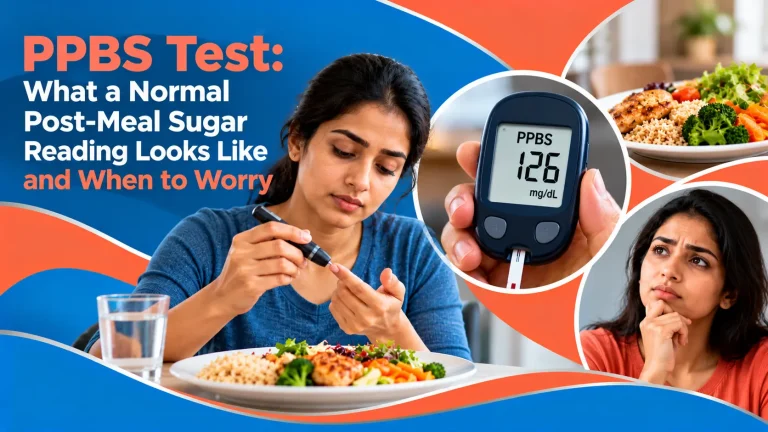
You walk out of a routine consultation with a slip from your doctor that mentions “PPBS test,” with no explanation attached. Likely someone has referred to it before; probably your parent or neighbor living with diabetes; you would just nod your head without any idea of what it measures.
The PPBS test procedure is fairly straightforward: you eat, then wait 2 hours and have your blood drawn to get a number without knowing what it means. This article will help you understand PPBS test results and their normal range.
What Is the PPBS Test and What Does PPBS Stand For?
PPBS full form is Postprandial Blood Sugar. It’s one of the most common tests on a diabetes report. The idea is simple. 2 hours after your first bite, your blood is checked to see how well your body has handled the sugar from that meal.
Food raises blood sugar, that’s normal. What happens next is what matters. A healthy body brings that spike back down within a couple of hours. A body struggling with insulin doesn’t, and the sugar lingers. That gap between the two is exactly what this test is built to catch.
You’ll rarely see it ordered alone. Doctors usually pair it with a fasting blood sugar test, and for good reason. Fasting sugar tells you your baseline, the resting state. PP sugar level tells you what fasting can’t: how your body handles food once it hits your system.
How Is the PPBS Test Done?
There’s not much to it. Do not fast the previous night, no preparation needed, just follow your regular routine.
- Have your regular meal (most testing centers recommend that you have about 50 to 100 grams of carbohydrate intake in a 20-minute span).
- Remember the exact moment you started eating and not when you finished eating
- Blood gets drawn exactly 2 hours from that starting point
- No medication changes needed unless your doctor tells you otherwise
Timing trips people up more often than you’d expect. If you draw blood at 90 minutes or delay it to 3 hours, the result won’t provide an accurate picture.
What Is The PPBS Test Normal Range?
This is the part everyone skips ahead to, so here it is, straight up.
| Category | PPBS Reading (2 hours after eating) |
|---|---|
| Normal | Below 140 mg/dL |
| Prediabetes | 140 to 199 mg/dL |
| Diabetes | 200 mg/dL or higher |
- Under 140 mg/dL, your body is processing the meal’s glucose exactly as it’s supposed to
- 140 to 199 mg/dL puts you in prediabetes territory, a warning worth noting, not a diagnosis to panic over
- 200 mg/dL or above brings diabetes into the picture, especially on a repeat reading, and that’s worth a doctor’s attention
Worth checking before you compare your own report to this table: these ranges assume a standard 2-hour draw. Some labs use a 1-hour or 90-minute marker instead, and that shifts the reference range entirely. Confirm what your report actually measured first.
Why Does the PPBS Test Matter More Than People Think?
Fasting sugar gets most of the attention in a routine checkup. PP sugar level, though, often catches a problem first.
Here’s the pattern doctors watch for. Fasting sugar looks completely normal, yet blood sugar quietly spikes after every meal. It’s common in early type 2 diabetes, and it shows up well before fasting numbers ever turn abnormal. Miss this stage, and you also miss the window where diet and exercise changes alone can still turn things around.
In India, that window matters even more. Consider the numbers:
- 11.4% of Indian adults already have diabetes
- 15.3% more are already prediabetic
- That’s over 101 million people living with diabetes today
- Another 136 million are heading there without knowing it
These figures come from the ICMR-INDIAB study, published in The Lancet Diabetes & Endocrinology. A PPBS test remains one of the simplest, cheapest ways to catch that shift while there’s still time to reverse it.
What Causes a High PPBS Reading?
A high reading after eating doesn’t automatically mean diabetes. It does mean something’s worth a closer look.
- If you have high results, then it may be due to one of these:
- Your body’s cells normally absorb sugar after insulin stimulation. However, in insulin resistance, this does not happen.
- Type 2 Diabetes, which is undiagnosed or poorly controlled
- Taking a high intake of refined sugar meal just before the test
- Steroids or similar medications that push blood sugar up temporarily
- Stress, or a sudden illness around the time of testing
- A pancreatic condition that disrupts insulin production
More than one of these can affect your reading at once. That’s why a single high number isn’t a diagnosis. A second test, often with an HbA1c, gives a clearer answer.
What Symptoms Come With High Post-Meal Blood Sugar?
Here’s the tricky part. Plenty of people walk around with high post-meal sugar and feel absolutely fine. This is exactly why regular testing matters. You can’t rely on feeling unwell. If symptoms do appear, look out for:
- A wave of tiredness an hour or two after meals
- Thirst that feels excessive, especially right after meals
- Running to the bathroom more than usual
- Vision that blurs and clears on and off
- Cuts or wounds taking longer than normal to heal
- Losing weight without trying to
Notice any of this repeating after meals? Don’t wait for your annual checkup. Get a PPBS test done sooner.
How Should You Prepare for a PPBS Test?
Preparation here is minimal, but a handful of things can affect how accurate your result turns out.
- Eat your usual meal, the normal portion you’d actually have, since the test is meant to reflect real eating habits
- Don’t skip the meal beforehand. This totally misses the point of the test.
- Avoid strenuous exercise shortly before undergoing the test, because this will reduce blood sugar temporarily.
- Inform the lab of your medication use, particularly those for treating diabetes.
- Drinking water is acceptable during the 2-hour period.
- A single figure never tells the whole truth.
When Should You Talk to Your Physician about Your PPBS Test?
One number rarely tells the whole story. Some patterns, though, shouldn’t wait.
Get it checked if:
- Your PPBS result is 200 mg/dL or more, even if it happens only once
- Many repetitions of the test place you in the prediabetic group
- The elevated reading accompanies the symptom of thirst, frequent urination, or unexplained fatigue
- There is a family history of diabetes, and more than one year has passed since your previous screening
- Your fasting sugar level is normal, but some other signs do not fit into this picture
A general physician or diabetologist in Mumbai won’t just look at your PPBS in isolation. It will be analyzed together with your fasting sugar level and HbA1c to have a full picture.
Getting Your Post-Meal Sugar Checked the Right Way
One meal, one blood draw, 2 hours of waiting. That’s all a PPBS test asks of you, and in exchange, it can catch a problem long before it turns into a diagnosis you can’t walk back. It picks up on things a fasting test, taken alone, often misses entirely.
If you’re in Mumbai and looking for proper guidance on your results, the diabetology specialists at Wockhardt Hospitals Mumbai can help you understand what your PPBS number means for you specifically, not just what the reference range says.
Numbers drifting upward over the last year? Never actually had a post-meal sugar test? Either one is reason enough to get it done now, rather than waiting for your annual checkup.
Frequently Asked Questions
1. What is PPBS full form?
Postprandial Blood Sugar. It’s a simple blood test that checks your glucose level exactly 2 hours after you begin eating a meal.
2. What is a normal PPBS test range?
Below 140 mg/dL is normal. A range between 140 and 199 is prediabetes. At 200 or above, diabetes is on the table.
3. Is PPBS basically the same thing as a random blood sugar test?
Not quite. A random blood sugar test can be done at any time, whether you’ve eaten or not. PPBS is different. It’s taken exactly 2 hours after you start a meal, so it’s far better at picking up sugar spikes after eating.
4. Can your PPBS levels come back high even when your fasting sugar looks perfectly normal?
Yes, and this is actually a pattern doctors come across quite frequently in the early stages of type 2 diabetes. Post-meal sugar tends to climb before fasting sugar shows any change, which is why both tests are usually done together.
5. Is fasting necessary before a PPBS test?
Not for this one. Eat a normal meal, get tested 2 hours later. Fasting would defeat the whole point here.
6. How frequently should someone get their PPBS levels checked?
Healthy with no risk factors? Yearly is enough. But if you’re already prediabetic, have diabetes in the family, or notice things like constant tiredness and thirst, expect your doctor to want it checked every three to six months instead.
7. Can stress affect my PPBS reading?
Yes. Stress and illness can both push your blood sugar levels up. One high reading during a tough week doesn’t necessarily mean you have diabetes.
8. What should I eat before a PPBS test?
Just eat what you normally would. Skipping carbs to get a “better” result defeats the purpose of the test. Aim to finish within 20 minutes.


