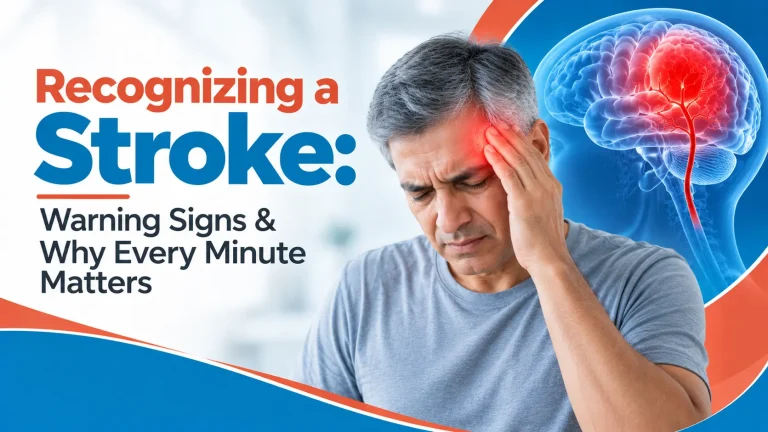
Most people equate the word stroke with an abrupt event, such as a sudden collapse, an event that occurs without any prior signs. However, that is not usually the case.
Most often, your body allows you some time, whether that be a few minutes or even a bit more, and what you choose to do during this short period will make all the difference.
Watching for stroke symptoms as they occur, instead of waiting to see if they pass, can be the difference between walking out of the hospital and years spent relearning basic things.
What Exactly Is a Stroke?
A stroke occurs because of reduced or interrupted flow of blood to any part of the brain. This is very serious since brain cells cannot survive long without oxygen and nutrients.
There are two main types worth knowing, since that explains how treatment approaches vary between patients:
- Ischemic Stroke: It happens when a blockage in an artery reduces blood flow to the brain.
- Hemorrhagic stroke: It is caused when a blood vessel bursts or starts bleeding in the brain or the adjacent tissues.
- Transient Ischemic Attack (TIA): It is also known as a mini-stroke. Symptoms of stroke in a TIA appear for a brief period of time and usually fade within an hour. It could signal a future stroke.
What Are the Common Warning Signs of a Stroke?
Recognizing brain stroke symptoms fast is really what the rest of this article hinges on. And here is the thing about most stroke symptoms: they appear suddenly and commonly affect one side of the body.
- Being confused and unable to comprehend what someone is saying.
- Sudden numbness or weakness, radiating towards one side of the body, arms, legs, and face.
- Slurred speech or difficulty speaking.
- Visual disturbances may include blurred vision, darkened vision, or black spots in one or both eyes.
- A sudden, severe headache that people say later was the worst of their life.
There is a simple way to hold onto these brain stroke symptoms when panic sets in, and your brain refuses to think straight. It is called FAST, the same test used by emergency responders across the globe, including the CDC and the American Stroke Association.
- F for Face. Ask them to smile. Check if one side is drooping.
- A for Arms. Ask them to lift both arms together, and see if one arm sinks back down without them noticing.
- S for Speech. Get them to repeat a short sentence after you. Does it come out strange, slurred, off?
- T for Time. Even one of these on its own is reason enough to call emergency services immediately. Not after breakfast. Now, this minute.
Does a Stroke Affect Differently in Women and Younger People?
Yes, on top of everything mentioned above, women having a stroke can also experience:
- Fatigue or heaviness in the body that has no obvious explanation
- Nausea or vomiting that comes on out of the blue
- Hiccups that won’t stop, causing a strange discomfort in the chest
- A sudden change in mental state, confusion, or simply not responding the way the brain normally does
One more thing worth knowing: stroke symptoms are not limited to older people only; more cases keep turning up in people under 45, a lot of it tied back to high BP or blood sugar that went unmanaged for years.
So no matter your age, don’t dismiss a FAST sign as stress or a bad night’s sleep.
Why Does Every Minute Matter?
Here is a number that tends to stop people mid-sentence. According to a published research journal on stroke from the AHA, during an untreated ischemic stroke, roughly 1.9 million neurons die every single minute.
“Time is brain.”You’ll hear doctors say this a lot, and it’s not an exaggeration for effect; it’s just true. In India especially, reaching a hospital quickly can be a real challenge.
Traffic, distance, gaps in emergency access – any of these can eat into the minutes that actually matter. The longer you delay treatment, the higher the risk of permanent disability.
The early identification of the signs and prompt arrival at the doctor is, actually, the key to success.
What Are The Risk Factors Involved?
A short list of conditions accounts for most strokes, and here is the good part: a lot of them can be managed once you know they exist.
Regular testing of blood pressure, sugar, and cholesterol is one of the easiest ways to diagnose the problem even before it becomes serious.
- High blood pressure, being one of the key risk factors in strokes.
- Atrial fibrillation or other arrhythmias, which create small blood clots in the bloodstream that can travel up to the brain.
- High cholesterol, causing plaques in the arteries.
- Diabetes, silently damaging blood vessels.
- Excessive smoking and alcohol abuse, causing high BP and blood sugar, which in turn damage blood vessels in the process.
- Over-sitting, being overweight, and physical inactivity.
- Family history of stroke, due to genetic reasons or heart diseases that might have occurred in the family.
How Is a Stroke Diagnosed?
The physician conducts various tests to identify the category of the stroke and the area of the brain where it occurred.
- Brain Scan (CT or MRI) to detect the nature and location of the stroke.
- Blood tests to measure blood sugar and coagulation properties and to exclude other diseases that might have similar symptoms.
- ECG is performed within an hour to assess any arrhythmia of the heart, such as atrial fibrillation.
Most of this is done within the first hour because each result points to a decision that can’t be put off.
How Is a Stroke Treated?
What comes next depends a lot on the type of stroke and, once again, on how quickly the person reached the hospital.
- A clot-dissolving medicine, called thrombolysis, works best when it’s given within four and a half hours of the first sign.
- There’s also mechanical thrombectomy, where the clot is physically pulled out, and this can still help some people even a few hours later.
- Surgery, used for bleeding strokes to ease the pressure or fix the vessel that burst
- Treatment after the stroke – physiotherapy, speech and occupational therapy after the patient’s condition becomes stable
Is a Stroke Preventable?
It is possible to control some forms of stroke by consistently controlling risk factors, rather than paying attention to them only occasionally.
- Watch your cholesterol and blood sugar closely.
- Diet, exercise, and taking your medications on schedule all matter here.
- Alcohol and cigarettes don’t help, so leave them out.
- Moderate exercise, most days if you can manage it, including a brisk walk.
- Take brief neurological symptoms seriously, even if they are quite brief and small.
What To Do If Someone Exhibits These Signs?
There is absolutely no necessity to take the individual to the hospital by yourself. You can contact emergency medical services, and they can take it from there in serious cases. Never leave the patient alone until the specialists arrive.
- Note the exact time symptoms started; this detail shapes what treatment doctors can even offer later.
- Help them lie down and stay calm, with the head raised just slightly.
- Skip food, water, and medication entirely.
- Keep an eye on their breathing and how alert they seem.
What Does Stroke Recovery Actually Look Like?
- Speech-Language therapy for assisting in speech, language and cognitive disabilities, and swallowing therapy.
- Physical therapy for assisting patients in increasing their strength and mobility.
- Occupational therapy for assisting patients in increasing their ability to use their hands and arms through activities of daily living like getting dressed or taking a bath.
- Physiatry for assistance in dealing with pain and spinal disorders.
- Psychological therapy for emotional and psychological effects post-stroke.
When Do I Need to See a Neurologist Near Me?
You must visit a neurologist immediately if you notice symptoms of stroke or suffer from health conditions like hypertension, diabetes, or irregular heartbeats. Dr. Pavan Kishore Pai is a renowned Interventional Neurologist and Stroke Specialist who can help you with the diagnosis and treatments.
You can visit him at Wockhardt Hospital Mira Road for further assistance. Remember, being in touch with a neurologist near me constantly reduces the chances of recurrence.
Frequently Asked Questions
1. What are the initial signs of a stroke?
The most common symptoms of a stroke occur suddenly and tend to affect one side of the body – face sagging, arm weakness, and difficulty speaking. You can check or perform the FAST test (Face, Arms, Speech, Time) to identify them. You should contact the emergency services immediately if you notice anything of that sort. At times, the signs of a stroke will disappear within an hour; this may be a TIA or mini-stroke. It acts as a predictor for a potential stroke and cannot be overlooked.
2. Do stroke symptoms simply disappear?
In some cases, there may be signs of a stroke that go away after an hour. This can be a transient ischemic attack or a mini-stroke, which is usually a warning sign of a future stroke and must not be taken lightly at all. See a neurologist near me even if symptoms disappear.
3. Are there any additional stroke symptoms in women?
Yes. Women can experience unexpected exhaustion, sudden vomiting, hiccups with chest pain, and confusion, apart from typical stroke symptoms.
4. Can young people also get strokes?
Stroke is no longer limited to the older population. More cases have been discovered in younger patients because of poor management of high blood pressure or high blood sugar.
5. How is a stroke treated?
It varies depending on the type of stroke and how soon the person can be hospitalized. Treatment is given using thrombolytics, medicine to dissolve blood clots if hospitalization is within 4.5 hours, and mechanical thrombectomy, removal of the clot.