Are your Parkinson’s disease symptoms starting to run your day, instead of the other way around? If so, you may wonder if deep brain stimulation (DBS) can help.
DBS may help some people whose movement symptoms are troublesome and no longer consistently controlled by medicines.
But it is not the next step for everyone with Parkinson’s disease. The right patient needs the right diagnosis, symptoms, expectations, and overall health profile.
This guide explains who may be eligible for deep brain stimulation, what doctors look for before DBS surgery, and what to expect at your pre-surgery assessment.
What is Deep Brain Stimulation?
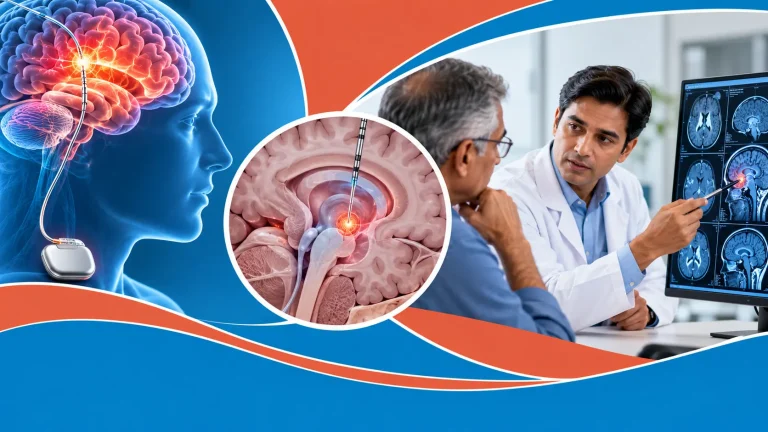
Deep brain stimulation is a surgery in which a small neurostimulator is placed to send controlled electrical pulses to targeted areas of the brain that control movement. The aim is to alter abnormal brain signals and ameliorate certain symptoms.
DBS is most commonly used to treat Parkinson’s disease and a few other movement disorders, depending on the case.
But DBS surgery is not a cure for Parkinson’s disease. It is a treatment intended to control some symptoms and possibly improve daily functioning and quality of life.
Who May Qualify for Deep Brain Stimulation?
No checklist automatically makes someone eligible. A specialist team reviews the full clinical picture and determines whether deep brain stimulation may be appropriate.
People with Parkinson’s disease might be candidates for DBS surgery when they:
- Have problematic motor fluctuations (e.g., return of symptoms before the next medication dose)
- Dyskinesia or involuntary movements that affect daily life.
- Tremor that persists as disabling despite adequate medication therapy.
- A good response to levodopa or other dopaminergic treatments, even when the medication has become difficult to tolerate.
- Symptoms that continue to interfere with work, mobility, independence, or quality of life despite optimized medical treatment.
There is no single test that can confirm whether DBS is right for you. Doctors look at the big picture, i.e., how symptoms will affect your routine and how your body responds to medication.
This thorough evaluation helps the medical team determine whether DBS is the appropriate next step for you.
A Simple Way to Understand It
| Situation | Could DBS Evaluation Be Considered? |
| Parkinson’s symptoms are well controlled with medicines. | Usually, DBS surgery may not be needed at this stage. |
| Medicines work, but symptoms wear off unpredictably. | Yes, an evaluation for deep brain stimulation for parkinson’s, may be appropriate. |
| Severe dyskinesia affects daily activities | Yes. |
| Tremor remains disabling despite appropriate treatment | Yes. |
| Diagnosis is uncertain or may be atypical Parkinsonism. | Further specialist assessment is needed. |
| Significant untreated psychiatric or cognitive concerns. | These may need to be addressed before deep brain stimulation surgery. |
The decision should always be individualized by a qualified neurological and neurosurgical team.
Is There a Specific Age or Disease-Duration Cut-Off?
This is one of the most frequently asked questions about deep brain stimulation for Parkinson’s disease.
The answer is not as simple as it seems. Many people assume you must be a certain age, or have had Parkinson’s for a set number of years, but it isn’t that simple.
Recent expert recommendations suggest that age, disease duration, disease stage, or one motor-score measurement should not be the only determinants of deep brain stimulation candidacy. Instead, doctors look at the diagnosis, symptom pattern, response to medication, cognitive and psychiatric health, general medical fitness, and what the person wants.
Longer disease duration historically has been used during patient selection as it can help to differentiate typical Parkinson’s disease from conditions that can appear similar.
However, more recent expert recommendations focus on timely referral instead of waiting for very advanced symptoms.
Note: If symptoms of Parkinson’s are becoming difficult to manage with appropriate medicines, it may be worth talking to a movement-disorder specialist about deep brain stimulation instead of waiting until daily life is severely impacted.
What Does the Pre-Surgery Assessment for DBS Involve?
Prior to deep brain stimulation, your doctor will perform a comprehensive evaluation to learn about your symptoms, your response to medication, your overall health, and your treatment goals. The team can now decide if DBS surgery is the right choice and safely plan the procedure.
Evaluation for deep brain stimulation for Parkinson’s disease includes:
- Neurological Examination: A neurologist will examine your Parkinson’s symptoms, movement problems, tremor, stiffness, balance, and motor fluctuations. They also check how these symptoms affect your day-to-day functions.
- Medication and Levodopa Assessment: Your doctor will review the medications you take, including their benefits and side effects. They may also check how your symptoms change when the medicine is working and when its effect wears off.
- Brain Imaging: Your doctor may recommend an MRI or other scans to examine the structure of your brain for anything that could influence surgical planning or treatment.
- Cognitive and Psychological Assessment: Memory, attention, thinking abilities, mood, and mental health can be tested. So doctors can determine if any issues need to be addressed before DBS surgery.
- General Health Assessment: You may need blood tests, a heart check, an anesthetic assessment, and other investigations depending on age, medical history, and existing health conditions.
- Neurosurgical Consultation: The neurosurgeon describes how the procedure works, possible benefits and risks, recovery, device programming, and long-term follow-up. You can also talk about your expectations and concerns about deep brain stimulation.
The DBS Pre-Surgery Assessment at a Glance
| Assessment | What Doctors Want to Understand |
| Neurological examination | Diagnosis and movement symptoms |
| Medication review | Which medicines help and what side effects occur |
| Levodopa response | Which symptoms are medication-responsive |
| Brain MRI/imaging | Structural assessment and surgical planning |
| Cognitive testing | Memory, attention, thinking, and executive function |
| Psychiatric assessment | Mood, behavior, and emotional stability |
| Neurosurgical consultation | Surgical suitability, risks, and expectations |
| General health assessment | Fitness for surgery |
| Family discussion | Support system and realistic expectations |
A Useful Question to Ask: Which Symptoms Will DBS Actually Help?
Before deciding on DBS surgery, ask your doctor to separate your symptoms into three categories:
Symptoms Probable to Improve
These may include tremor responsive to medication, rigidity, bradykinesia, and some motor fluctuations.
Symptoms that May Improve in Less Predictable Ways
Some gait, balance, speech and swallowing problems may not be as consistently responsive, especially when they are not medication responsive.
Symptoms DBS is Not Meant to Treat
DBS does not stop the progression of the underlying Parkinson’s disease. This difference before deep brain stimulation can help you and your family make a better-informed choice.
What Should You Bring to Your DBS Consultation?
A bit of preparation before deep brain stimulation can make the appointment much more useful.
Think about bringing:
- A full list of medicines and doses.
- Previous MRI/scan reports.
- Major medication side effects log.
- Notes on “ON” and “OFF” periods.
- A list of symptoms that cause the most interference in daily life.
- Questions from relatives or caregivers.
- Previous neurological reports if available.
It can also be helpful to keep a short symptom diary for several days. Record the time at which medicines were taken, the time at which the symptoms improved, the time at which the symptoms returned, and the time at which dyskinesia occurred.
This gives your neurologist a clearer picture of your day before evaluating deep brain stimulation for Parkinson’s disease.
What Happens After DBS Surgery?
DBS surgery is not the end of the road for treatment. After the procedure, the implanted device will need to be programmed and adjusted based on your symptoms and response. These settings are generally tweaked over time rather than set in one visit.
Regular follow-ups help the medical team:
- Improve symptom control by stimulating better.
- Review and adjust Parkinson’s medications as needed.
- Monitor your recovery and overall well-being.
- Discuss new symptoms, concerns, or device-related issues.
- Learn how to control your DBS system in daily life.
This is why choosing a center with the right neurological, neurosurgical, and follow-up support is an important part of planning deep brain stimulation treatment.
Deep Brain Stimulation Surgery in Mumbai
For those looking at deep brain stimulation surgery in Mumbai, the most important thing isn’t just to find a center that offers deep brain stimulation. Choose a team that can offer:
- Appropriate patient selection.
- Neurologic evaluation.
- Neurosurgical expertise.
- Cognitive testing.
- Programming.
- Long-term follow-up.
Wockhardt Hospitals provides information about DBS services and has compiled a list of neurological and neurosurgical specialists affiliated with its DBS care in Mumbai and other locations.
Similarly, someone searching for a neurologist in Mumbai for Parkinson’s symptoms may be better served beginning with a specialist consultation, with an emphasis on diagnosis, medication response, and whether an advanced treatment such as deep brain stimulation should be considered.
The goal must always be the right treatment for the right patient, not surgery because it is there.
Final Takeaway
Choosing deep brain stimulation is not just a decision to have brain surgery. It is a choice about whether DBS surgery is the right treatment for your specific symptoms, health, goals, and lifestyle.
If symptoms of Parkinson’s disease are becoming difficult to control despite carefully adjusted medications, you might want to talk with a qualified neurologist in Mumbai or a movement-disorder specialist about DBS.
A comprehensive evaluation can help answer the most important question: am I likely to benefit from DBS, and what can I realistically expect from it?
For patients exploring deep brain stimulation surgery in Mumbai, Wockhardt Hospitals provides advanced neurological treatment and an opportunity to discuss symptoms and treatment options with the neurology and neurosurgery teams before deciding.
Frequently Asked Questions
1.Who is eligible for deep brain stimulation surgery?
A person with a diagnosed movement or neurological disorder whose symptoms no longer respond well enough to medications is eligible for DBS surgery. In most cases, this applies to patients with Parkinson’s disease, essential tremor, or dystonia.
2. Who is not a candidate for deep brain stimulation?
Patients with advanced dementia, significant cognitive decline, or atypical parkinsonian syndromes that do not respond to medications are not eligible for DBS surgery.
3. What are the most common indications for deep brain stimulation surgery?
Standard medications can no longer control symptoms in a few cases. This is where DBS surgery comes in and helps you treat movement and psychiatric disorders.
4. What is the cost of deep brain stimulation surgery in India?
Deep brain stimulation surgery in India costs between ₹5,00,000 and ₹20,000,000, depending on the hospital, city, and device type. It’s always recommended to contact the hospital you choose for consultation and a tentative budget for the surgery, if it’s needed.
5. How painful is DBS surgery?
DBS surgery is generally not painful because the brain itself lacks pain receptors and local numbing medication is used on the scalp and skull.